

Automated Value Method (AVM) vs CMA vs The New CMA
Understanding the Mistake AVMs Make
A Radius Search Doesn't Understand Common Sense
When it comes to pricing homes many sellers are looking at online resources like Zestimate, XHome or a slew of other AVM options. At times they will even bring them up to you as their agent to ask what your thoughts are. What most homeowners don't understand about these systems is how inaccurate they truly are. They are often a significant amount away from market price. Now they will claim to be accurate and even have 'stats' to prove it, but that is a misnomer I will address later in this blog post. They are not close to the value in many cases and this lies squarely in the way in which they search for data.
The search and data you include matters so much when it comes to home pricing. That's why we at Focus 1st teach a very specific searching method that is built into the Visual Home Values software. You have to get this right or you will be led astray. There are certain rules we harp on in particular to keep agents information correct. AVMs break almost every rule and often include incorrect data. By rule they simple do a radius search and include properties they think should fit, they often don't.
Let's look at an example and see what rules the search is breaking and how that could lead to major issues. The example here is of a house in a well defined subdivision with an HOA, HOA specific amenities and styles and is just to the north of a major road that cuts through this area of town.
When looking at the Zestimate of this house today we find the home on the map, and the 5 properties the AVM uses to establish price.
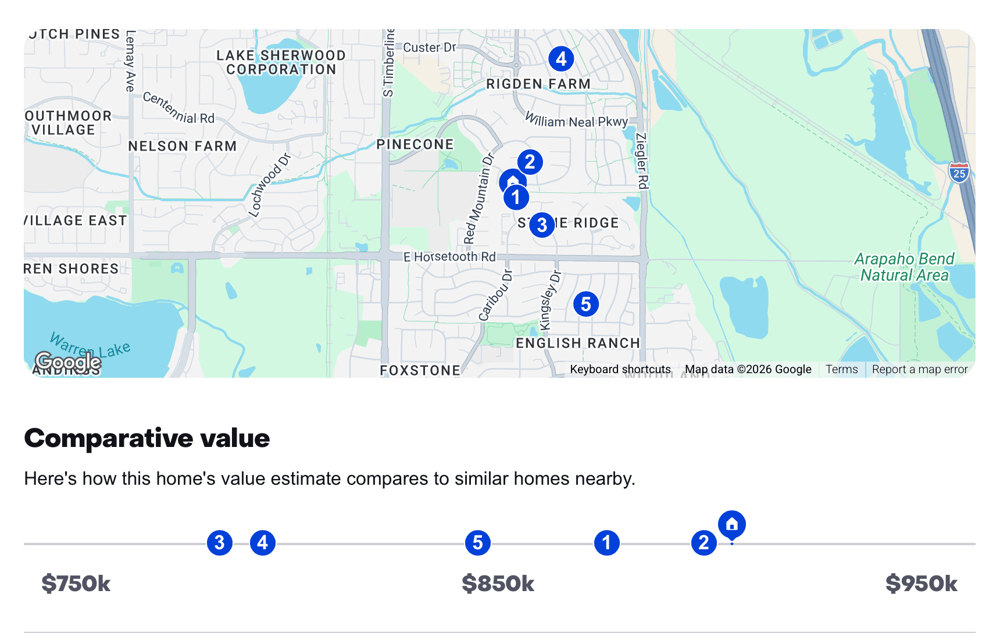
At first glance you may assume they are close to the house so they should all match as far as pricing goes when looking at this image. This is not true however. Looking at the data closer and using local knowledge that only an agent truly can leverage we can find issues with almost every dat point used to price the home. Let's talk about each home.
- #1: This property is actually a good comparison! (It's not as updated as our subject property, but it is relevant.)
- #2: Even though this house is so close the subject property, what isn't noted here is that it crosses into a different neighborhood. This other subdivision doesn't back to greenbelt like our subject property and doesn't have the HOA inclusions like a community pool.
- #3: This is where we start to see issues. This property is a townhome and thus prices different that our detached home.
- #4: This property is in a totally different subdivision that is not connected to ours at all. It's newer and much smaller, as well as doesn't have HOA inclusions.
- #5: This home sits in a subdivision across the major road, in an area that doesn't have HOA inclusions, back to greenbelts and prices differently because of it.
This search and included data could still work if you as an agent took time to adjust your pricing for this features, but the AVM doesn't do that.
Why Does It Matter?
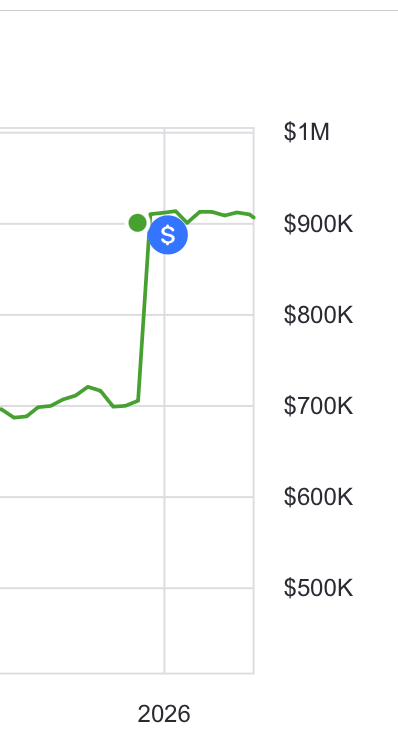
AVMs essentially take the information from this search and generate a price per square foot number. Then use that average to price your home. That can lead to major mistakes. In this case it lead to way too low of pricing. I say that because the value it has listed for the home of around $900,000 is not purely the AVM number. In this case it's been fixed, and it's the dirty secret of how they can claim to be accurate.
Why Do AVMs Seem Close Enough?
Error Correction Masks the Mistake
Every time a home sells, the Zestimate adjusts to match it. This means that after a recent sale the Zestimate is quite accurate and looks smart. But the longer it goes from last sale, the further off your AVM value becomes. In the example case here we can see it was more than a little off. As a matter of fact it was about $200,000 off on the value before the sale changed it. This error is from it's data and PSF calculation issue. The image below shows the Zestimate over time. Note the adjustment after the sale.
The final question many would ask is whether or not I just happened to find a crazy case. The answer however is actually much more simple.
Who is Really Giving AVMs Their Value?
If you think of every home that sells as an adjustment you can quickly see that it's not the AVM that's fixing itself, but rather the real estate agents. That's why Zillow and others can claim high accuracy. When an agent lists a home for sale in their system it adjusts the value to match close to the list price and after closing jumps to that number. So Zillow becomes more accurate, or at least they can claim it. The truth however is that:
AVMs are only ever as accurate as the agents that put the pricing into the data base.
So who really is getting it right?
AVMs will never replace CMAs done by agents who understand the market and area better than a map ever could, so be aware and be able to explain why the AVM is most likely wrong.
Don't Just Do the Same 'Better', Do Different
Why Are Clients Looking for More?
Why are clients so enthralled with AVMs? Everyone knows that the Zestimate isn't correct yet they look at it anyways and hope to see it go up.
It's true that many home owners may want to just feel the sensation of winning and wealth generation, but there is also a signal in their actions that shows real estate agents have a real opportunity. Many clients who look at the Zestimate want to understand the properties they're being compared to and get a better knowledge in the market. You can provide that for them better than any AVM can... and if you embrace the New CMA you can do it better than 99% of other agents.
The New CMA is the process and pricing method that gives you an advantage and connects to the fears and hopes of buyers and sellers better than the old CMA. It is a way to not only find value, but position against your competition, factor in market conditions and react correctly to changes. It's the way to turn clients into raving fans and help them get where they want to go. It does this because it's not just different than the old CMA it's better.
The Old CMA Process
- Subject Property: Understanding the basics of the home you're pricing, size, bed and baths, location (radius area).
- Compare to Recent Sales (+/- 10%): Look at recent sales close to the house (radius) that are close in size.
- 'Adjust' Top Three: Choose the three most alike sales and guess what the value of different features are.
- Show Stack of MLS Files: Shows the clients MLS print outs then tell them to trust you on the value.
This method of pricing was the standard from time eternal (not really, but you understand what I mean) until a former HP Engineer realized that there was a better way.
Using the data from the MLS and the engineering problem solving mindset that he honed over almost three decades as a top programmer and software manager he developed a better way.
The New CMA Process
- Subject Property: Understand the key features of the house, size, beds, bath, garage and location (subdivision or natural boundaries).
- Area Trends: Look at the sales trends (Odds of Selling, Time to Close, Buying Pattern) for their specific location (subdivision or natural boundaries).
- Value Trend Area Sold Homes: Put all the homes that sold in their location (subdivision or natural boundaries) onto a graph and find the sold price market trend line. Note: This is not price per square foot, but rather the actual statistical trend.
You're Not Done Yet... This Is Where It Gets Good!
- Look at Buyer Zone Market Conditions: Find the current competition and next 90 days future competition sales momentum and supply/demand balance aka opportunity, in the area and price range where potential buyers of your subject property will also be looking.
- Position Against Buyer Zone Competition: Price you home to meet the needed perceived value ranking to get the right attention for offers at market price, in the area and price range where potential buyers of your subject property will also be looking.
- Present Information To Sellers So They Understand: Put all of this into a format that an everyday person can actually understand and by the end of seeing it can tell you the right price!
While this new process seems hard to implement and confusing, it's actually simpler and more repeatable. There is not guessing, estimation or reaching out to builders to find replacement cost. Plus we built the Visual Home Values software to make it easy to do!
This New CMA is making ways around the US and has began to become the clear winner when it comes to pricing homes.
Learn more about the buyer zone and the competitive market analysis process in The New CMA: Competitive not Comparative available on Amazon or for FREE eBook Download.
AVMs vs The New CMA: A Clear Winner
AVMs have grown in popularity because homeowners want to understand the market and better track the value of their home. It is the biggest investment for many people they will ever make. As an agent you have an opportunity to truly help them. Do this in two ways:
- Help them understand that when it comes to AVMs, you will always be better!
- Connect with them more often to give them updates using the Real Estate Reviews process.
What is Visual Home Values?
Check out their website to learn how the Visual Home Values Software,
and the integrated AI tool can help you today!
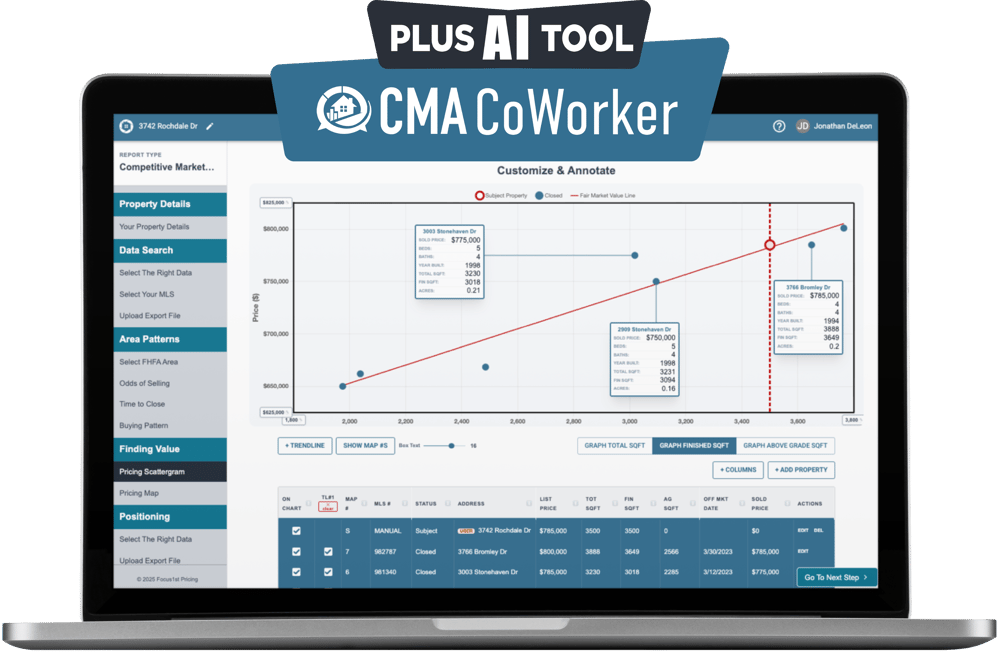
In this blog you've seen examples of graphs and reports from the Visual Home Values Software made by Focus 1st. If you've never heard of it, it's specifically built for agents to use their MLS searches to create pricing and reviews reports that answer key questions and help agents better than any other CMA software. It was created by a former HP engineer almost 20 years ago and has been changing the industry's understanding of how to competitively price listings.

PAGES
SOCIAL